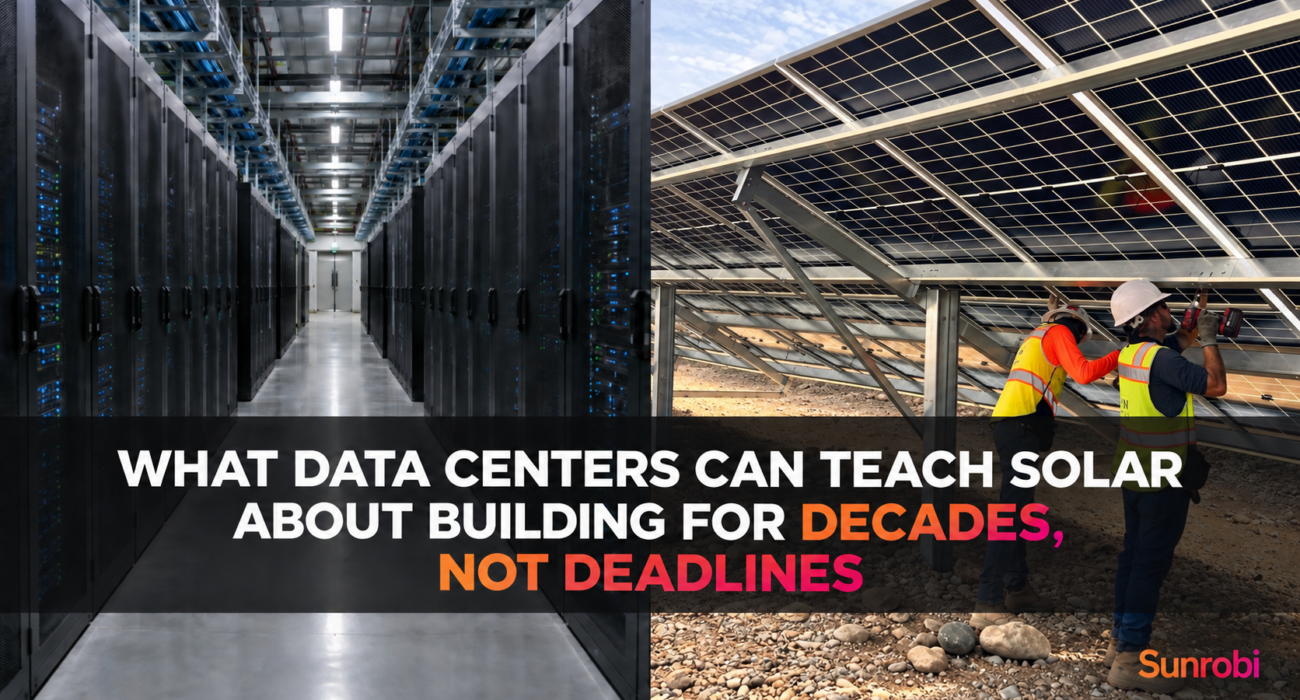
The conversation around electrification usually centers on generation — how much power we can produce, and how fast the grid can carry it. But a recent industry piece on electrical infrastructure inside data centers and manufacturing facilities made a different point: the systems inside a building matter just as much as the power feeding it, and those systems are being asked to evolve faster than the expertise and standards that support them.
Swap “data center” for “solar site” and the argument holds almost without edits.
Complexity Is Outpacing Expertise — In Solar, Too
Solar construction looks very different than it did a decade ago. Higher module counts, tighter interconnection timelines, more complex site logistics, and aggressive deployment targets have become the norm. Project schedules keep compressing, and as they do, the time available for careful sequencing, documentation, and knowledge transfer shrinks with them.
The result is a familiar tension: the industry’s growth in ambition is outpacing its growth in installation discipline. Everyone is being asked to build faster. Fewer people are being given the time to build consistently.
That gap doesn’t show up on installation day. It shows up years later, when a site needs maintenance, a component fails, or capacity needs to expand — and the original build quality determines whether that’s a routine fix or a costly teardown.
Three Foundations, Translated for Solar
The original piece frames reliable infrastructure as resting on three connected foundations: durable physical systems, a skilled workforce, and clear, well-understood standards. Solar construction rests on the same three legs.
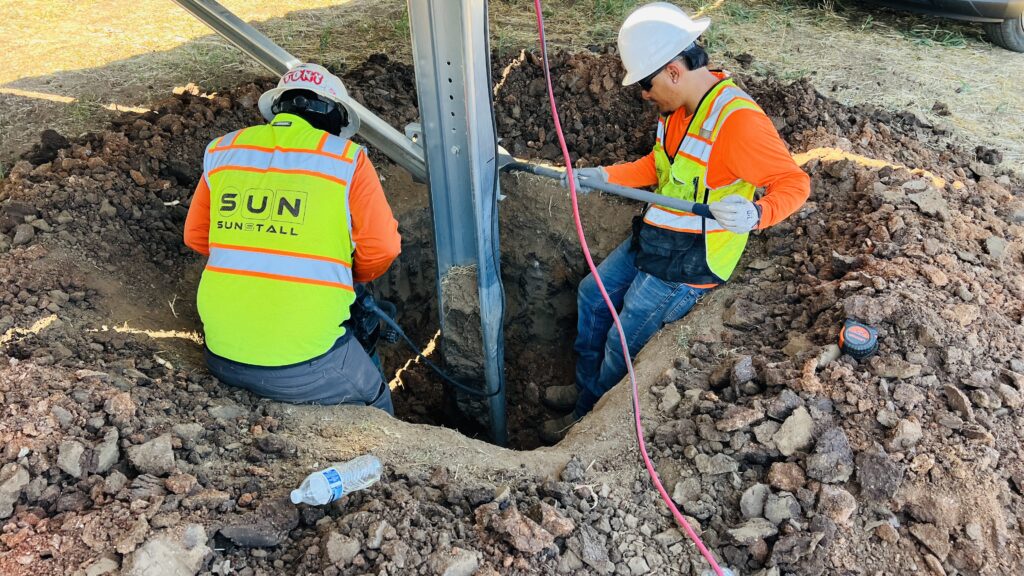
Durable installation. In solar, this isn’t about raceways and conduit — it’s about how pile driving, racking, and module installation are sequenced and executed. A site built with orchestration and consistency in mind creates something inspectable and serviceable years down the line. A site built purely for speed creates a black box that’s expensive to open back up.
A skilled, supported workforce.
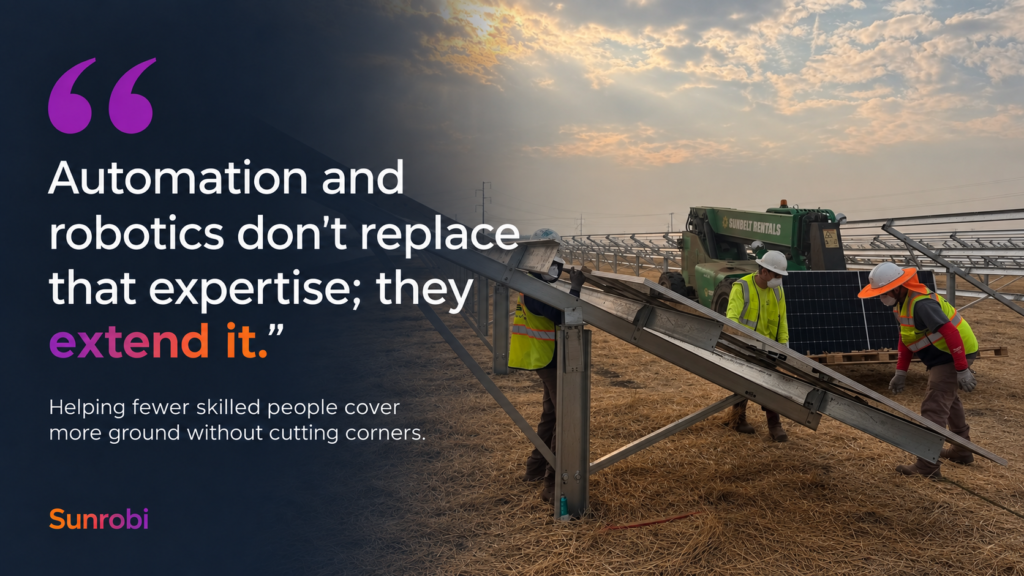
The knowledge required to install solar well — correctly, safely, and in a way that holds up for 25 years — keeps growing as equipment and site complexity grow. Automation and robotics don’t replace that expertise; they extend it, letting fewer skilled people cover more ground without cutting corners on the work that actually determines long-term performance.
Clear, shared standards
As solar projects get more complex, the biggest risk isn’t any single technology — it’s ambiguity. When every crew, subcontractor, and site has a slightly different way of doing things, quality becomes a matter of luck. Consistent, documented, repeatable processes are what let a project scale without scaling its risk.
Building for the Long Haul
Here’s the part that matters most: the payoff for getting this right doesn’t show up at commissioning. It shows up 10, 15, 20 years later.
A site installed with future adaptability in mind can absorb a capacity upgrade, a component swap, or a repair within its existing framework. A site where those considerations were skipped early on turns every future change into a disruption — more cost, more downtime, more complexity than it should ever have required.
Solar assets are expected to perform for a quarter century or more. That’s a long time to be living with decisions made in a matter of weeks during construction. The sites that hold up aren’t necessarily the ones built fastest — they’re the ones built with the discipline to still make sense a decade later.
The Real Differentiator Isn’t Speed
It’s tempting to treat installation as a construction-phase cost to be minimized — get it done, move on. But the facilities and industries getting this right are starting to treat their internal build quality as a long-life operational asset instead, worth the same care as any other capital investment.
Solar should think the same way. Predictable outcomes — consistent orchestration across pile driving, logistics, and module installation — aren’t just a way to hit a deadline. They’re what determines whether a site is still cheap to maintain, easy to expand, and reliable to operate two decades from now.
Speed gets a site built. Discipline is what keeps it running.
That’s the problem SunRobi is built to solve. By orchestrating pile driving, logistics, and module installation into one coordinated, predictable process, SunRobi helps developers and EPCs build sites that are fast to deploy and built to last — without trading one for the other.
If you’re planning your next site and want installation quality that still holds up in year 15, talk to the SunRobi team.