
Robots are very good at repetition.
Give a machine a validated process, predictable inputs and a properly prepared work area, and it can perform the same task consistently across thousands of repetitions.
But utility-scale solar sites are rarely that predictable.
Soil conditions change. Piles encounter refusal. Embedment depths vary. A pile type that works in one portion of the site may perform differently somewhere else.
Automation does not make that variability disappear. It makes early site intelligence even more important.
A Faster Process Still Needs the Right Process
The solar industry is increasingly exploring automation across the construction sequence—from pile installation and material transport to module placement and mechanical assembly.
That creates an understandable temptation to focus on equipment speed:
How many piles can it drive?
How many modules can it place?
How many labor hours can it reduce?
But before measuring how quickly a machine can repeat a task, the project team must confirm that it is repeating the correct task.
Pile testing helps establish that foundation.
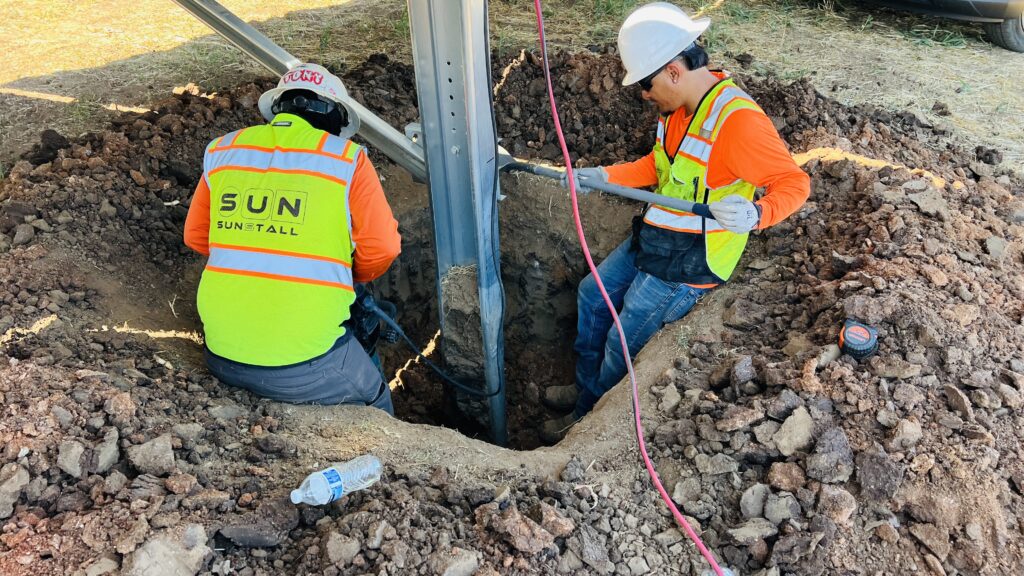
Testing can reveal whether the specified pile can withstand the required loads, reach its intended embedment depth and perform reliably in the site’s actual soil conditions. It can also identify areas where refusal mitigation, pre-drilling, grading changes or an alternative pile type may be required.
Those are not simply structural engineering decisions. They directly affect how the construction workflow should be planned.
Robots Need Ground Truth
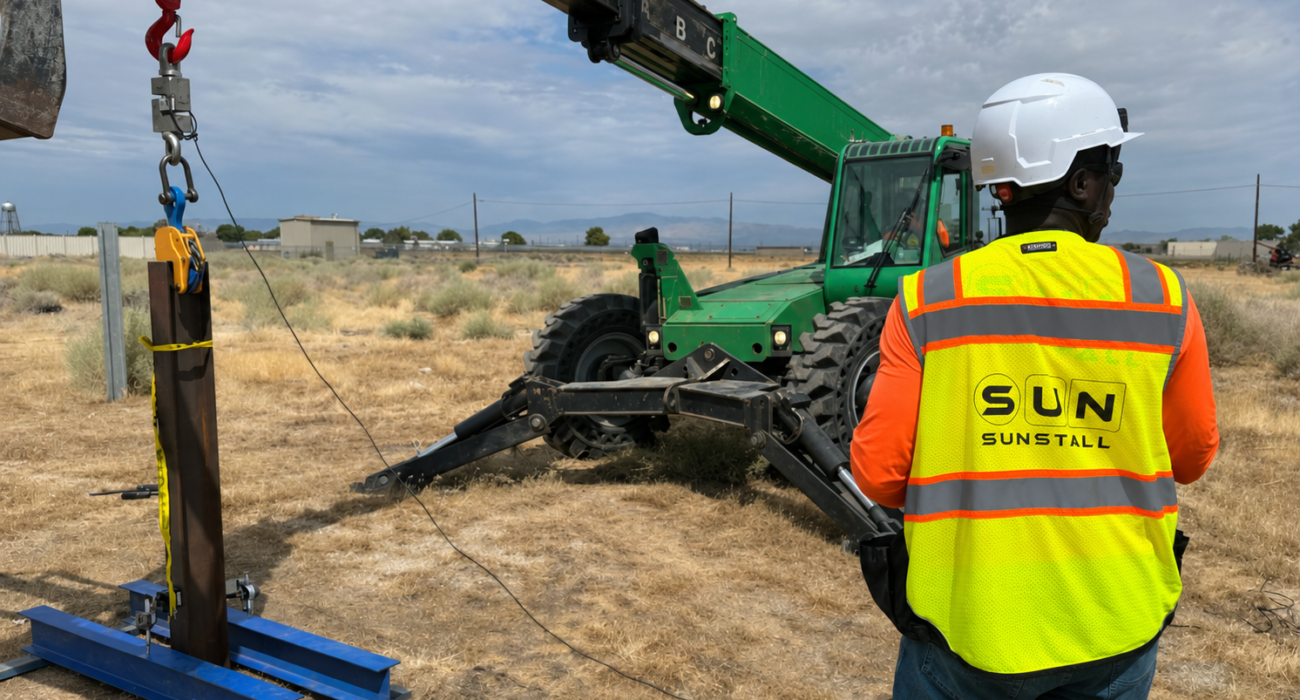
On one recent Sunstall pile test, 16 piles were installed across multiple locations and embedment depths.
Six encountered refusal.
Thirteen failed the horizontal load test.
The I-beams, however, passed both the horizontal and vertical tests.
If those results had been discovered during full production, the project could have faced redesigns, new material orders, equipment downtime and major changes to the installation sequence.
For a conventional crew, that creates expensive disruption.
For a robotic-assisted workflow built around repetition and production targets, it can interrupt the entire operating plan.
This is why pile-test data should not remain isolated in an engineering report. It can help inform the construction strategy:
- Which pile types should be used
- Where refusal is most likely
- Whether pre-drilling or grading is required
- Which areas are ready for automated production
- Where human crews and specialized equipment may be needed
- How equipment, materials and people should move across the site
The more connected this information becomes, the more intelligently the project can deploy both people and machines.
Automation Is Not the Absence of People
A robotic pile driver can execute a repeatable installation sequence, but people still define that sequence.
Engineers validate the foundation design. Site teams manage changing field conditions. Operators supervise equipment. Construction leaders decide how to handle exceptions that do not fit the standard workflow.
The goal is not to remove people from the site.
It is to give them better information, better tools and a more predictable operating environment.
When pile testing identifies difficult conditions early, the team can separate the standard production work from the exceptions. Robots can remain focused on the repetitive tasks they perform best, while skilled workers address the areas requiring judgment, adaptation or remediation.
That is how automation becomes useful in the field—not as a standalone machine, but as part of a coordinated construction system.
Site Intelligence Comes Before Site Autonomy
The future of solar construction will involve more automation, but the most successful projects will not begin with the robot.
They will begin with the site data.
Pile tests, geotechnical information, grading plans, digital layouts and field observations all contribute to the operating picture. Together, they help determine where automation fits, what the machine should do and where the workflow needs flexibility.
A robot can accelerate a strong construction plan.
It can also encounter the weaknesses in a poorly validated one much faster.
Before asking how quickly a site can be automated, we should ask a more fundamental question:
Do we understand the ground well enough to build a repeatable process on top of it?
.